
Many people think that only men can be colorblind. As we can learn from genetics, this is not true. There are a lot more men colorblind, but also women can suffer from a color vision deficiency.
Here’s a question for experts: according to a vision test in a magazine she did recently, my mother has a slight red-green weakness, which, however, is hardly noticeable in daily life. Is this also colour blindness, although that is really rare in women, and it’s nothing compared to her father’s colour blindness, which was pretty severe? Or can it be due to her being a carrier?
On a first glance it looks like we can give a quick and short answer on this. But thinking about it, makes it a bit more complicated.
First of all, yes women can be colorblind and even if it is a very weak form of it you call it color vision deficiency (a wording which reflects much better the fact that colorblind people can also see colors). And it doesn’t matter if it is rare or not.
XY = man
XX = woman.
Now let’s have a closer look at this case. We have a colorblind man which means he has a defective X chromosome which pairs with a Y. The Y chromosomes have no coding of color vision and therefore have no important role here. His daughter will inherit this defective X and another X from her mother. We have now to possibilities:
- The mothers X is also defective concerning color vision.
- The daughter inherited an X encoding perfect color vision.
In the first case the daughter definitely shows some form of color blindness which she inherited from both of her parents. It is said that the weaker form either from her father or from her mother would control her color vision.
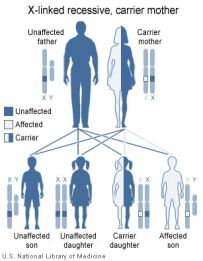
According to genetics the daughter shouldn’t be colorblind in the second case. But it is known from different cases that this isn’t always so easy to tell. Up to now it is not fully understood how those two X chromosomes affect the color vision system. It could be very well that both of them play their part in the setup of the color receptors. In this case the strong color blindness encoded on her fathers X chromosome could also affect the color vision to a certain degree.
Putting this together means, that the daughter can show characteristics of color vision deficiency in the first and the second case. Only a detailed genetic analysis could tell us more details about it.
Hi Daniel, thank you for your interesting and informative answer. Apparently, it seems my mother is one of the few colour deficient women, although hers is a very mild form, and the genetics behind it are not as self-evident as in most cases.
It’s not really a problem, since she sees most colours clearly and only has trouble with a few mixed shades, such as turquoise or some brownish reds and greens. We sometimes argue about the colour of shirts or shoes, but she usually has no problems matching her clothes.
Your article shows how ‘colour blindness’ is a somewhat misleading term, as it suggests a black or white situation (no pun intended), in which you either are or aren’t, whereas in fact colour vision is much more complex, with many shades in between. In a way this also applys to the ‘disability’ question. In my opinion, complete monochromacy obviously is a disability, while mild red-green deficiency clearly isn’t, but there is a broad spectrum of intermediary cases.
thanks for the facts. I had semester final for biology
This was an especially interesting article because my aunt is actually colorblind.. Thanks for the info!
Dear Daniel, my 6 yr. old daughter has been diagnosed with a red colour deficiency and cone dystrophy. My husband is not color blind. From all the reading I’ve done, I’m concluding he has to be for her to be color blind. Is this right? I’m a bit confused. Thanks, Terri
Terri, in most cases color blindness is an inherited disease, that’s true. But only inmost cases. There are many other circumstances which can cause bad color discrimination or other diseases which have as a side effect color vision problems.
As far as I understand it is the Cone Dystrophy which causes also the color vision problem. But I’m not a professional, so please contact your eye specialist to help you out on this. – All the best, Daniel.
Daniel,
My husband is completely color blind, he sees no colors. Is there a way for me to find out if I am a carrier because my young son seems to have some trouble with colors although he is only 2 and hard to tell just yet if it is his vision that is affected. I’d like to know if there is a chance he could be, but I am not sure I am a carrier. My parents are not color blind that I know of, but don’t know for sure about my Grandparents.
Dear Mckenzie. If your son would suffer from monochromacy he would be quite light sensitive, which should be easy to observe.
If you are a carrier or not might only be checked with a genetic test, which doesn’t really make sense in this case. Maybe you’ll find some further information in the article: Is my Son Colorblind?